A tray that performs well for 100 parts may still fail as a 100,000-piece programme. Repeated cavities amplify small errors in pitch, divider width and fit, while supply schedules, packing labour and revision control become as important as the first sample. High-volume custom EPE foam trays should therefore be purchased as a controlled production component, not as a generic sheet of foam.
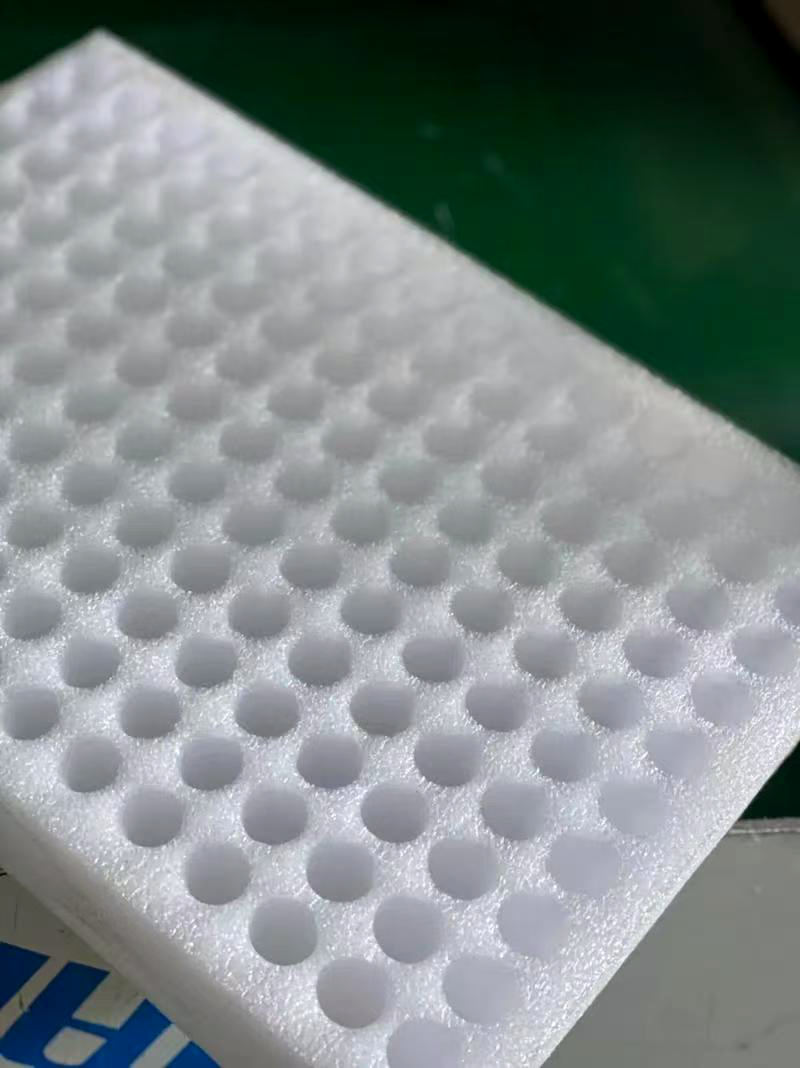
This guide is for European automotive component makers, electronics assemblers, contract manufacturers and distributors sourcing reusable or expendable trays for factory flow and export. It explains what a serious RFQ should contain and how Hongying’s 3,000+ m² EPE packaging facility can be evaluated for a recurring order.
Where High-Count EPE Trays Add Value
Multi-cavity trays can separate machined parts, moulded components, connectors, sensors, housings, bottles and subassemblies. They may move between a supplier and assembly line, sit inside a tote, or protect parts in an export carton. The same white or black foam appearance can hide very different requirements, so the use case must be stated first.
Define whether the tray is for one-way shipment, internal work-in-process, returnable circulation or final product presentation. This affects handling frequency, cleanliness, labelling, thickness and replacement criteria. A custom EPE foam tray manufacturer cannot price an appropriate solution from cavity count alone.
Automotive and industrial components
Metal or plastic components often need positional control, surface separation and a predictable part count at the assembly station. Oil, sharp edges, residual heat or burrs may affect the foam. Identify the actual production condition and confirm whether a protective bag, liner or pre-cleaning step is used.
Electronics and delicate subassemblies
Electronics may include connectors, pins, screens, sensors and cosmetic surfaces that must not carry load. Standard EPE should not be described as electrostatic protective without a defined grade and test method. If ESD performance is required, state limits, measurement conditions and validation frequency in the RFQ.
Build the Tray Around the Approved Part Range
Send a controlled drawing and samples representing production variation. State maximum and minimum dimensions, weight, centre of gravity and permissible contact zones. For moulded parts, include gate, flash and draft conditions. For machined parts, include coatings, caps and temporary protection fitted during transport.
The cavity must retain the smallest acceptable part without making the largest acceptable part difficult to load. A nominal CAD outline alone is not enough. If two suppliers make the component, test samples from both and define which condition controls the tray design.
Control insertion and removal
A tight fit can appear secure but create excessive operator force or surface rubbing. Finger notches, lead-in angles and safe grip areas improve ergonomics. Ask the sample team to time loading and removal with operators using gloves when that reflects the real line.
Pitch, Divider Width and Edge Distance
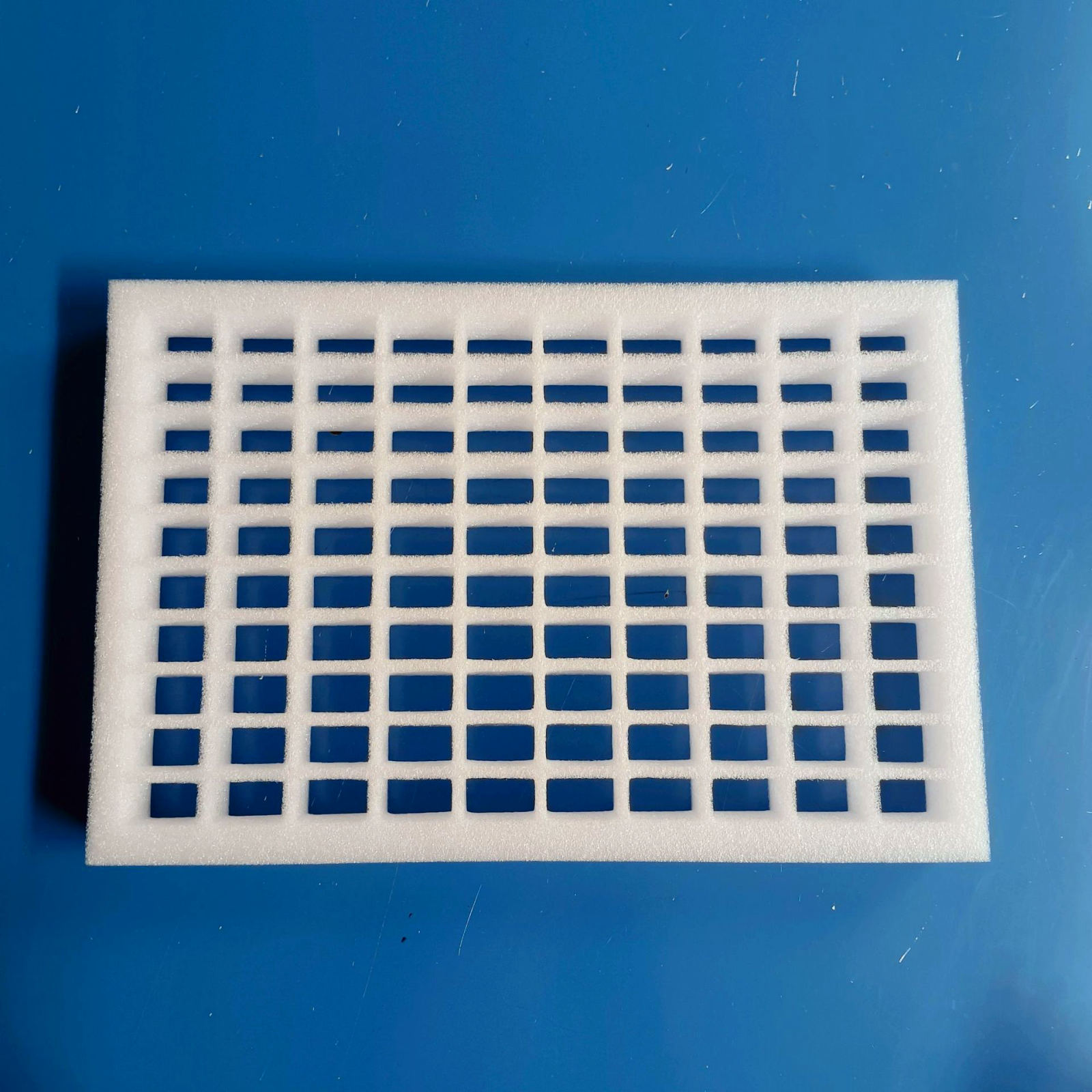
High-count trays depend on repeatable geometry. The drawing should list row count, column count, centre-to-centre pitch, cavity dimensions, outside size and orientation. It should also identify the narrowest divider and the minimum foam remaining between a cavity and tray edge.
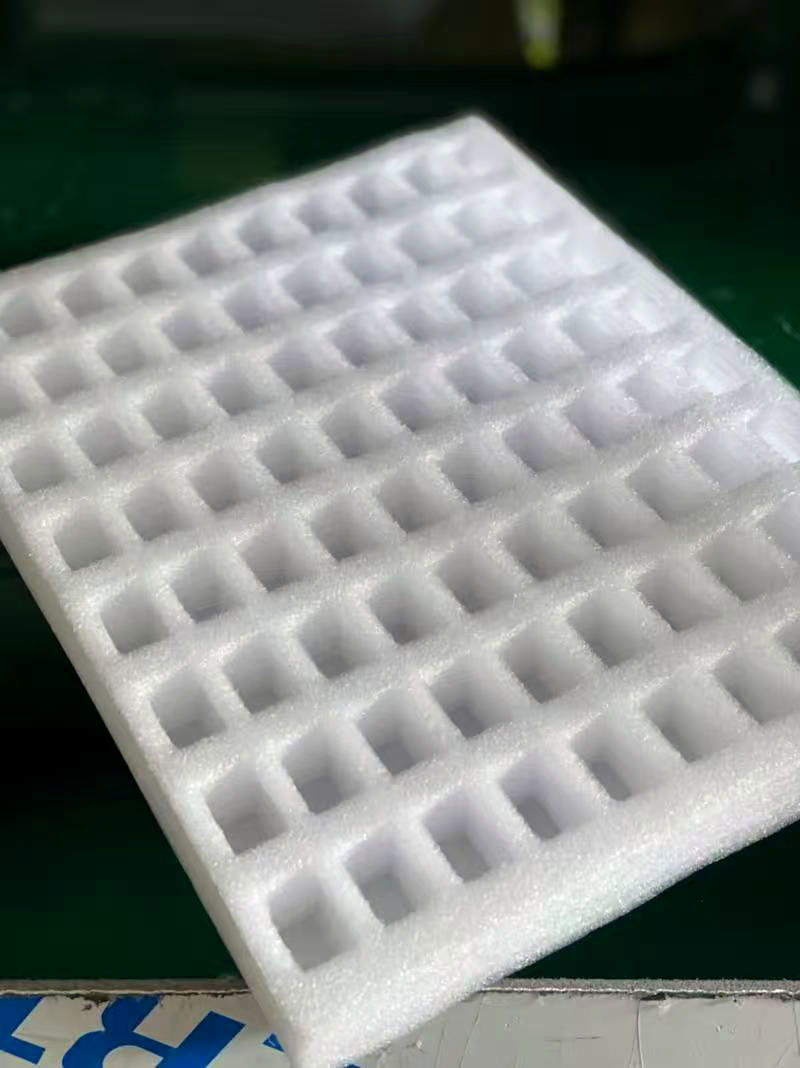
Reducing pitch may place more products in a tote, but a wall that is too thin can tear, bend or allow adjacent parts to touch. The design review should compare part density with handling durability. For heavy components, local wall strength and bottom support are often more important than maximising the nominal cavity count.
Plan the Tray, Tote and Pallet Together
Provide the usable internal dimensions of the tote, carton, rack or case—not just its external catalogue size. Include corner radii, handles, ribs, lid intrusion and stacking features. The EPE tray should fit without bowing and should be removable without tools.
Then calculate parts per layer, layers per container, containers per pallet and parts per shipment. A tray holding two extra parts may appear efficient, but not if its outside dimensions reduce containers per pallet. The right comparison is landed logistics efficiency across the whole system.
Check stack interfaces
If trays stack directly, define how the upper tray is located and where its load is transferred. Products must not carry the weight of upper layers unless specifically designed and tested for it. If a separator or rigid tote supports the stack, show that component on the assembly drawing.
Select Foam Construction for the Load
Foam density and thickness are different variables. A thicker low-density layer does not necessarily replace a thinner grade with different compression behaviour. State the required material by an agreed specification and approve the actual sample, rather than purchasing by colour and overall thickness only.
Layered construction can create deep cavities, a reinforced bottom or an open frame with less material. Bonding quality, alignment and local thickness become critical characteristics. For a large purchase, the drawing should show each layer and the finished assembly.
Do not hide sharp product features
A metal edge or protruding pin can cut foam during repeated use. Add clearance, a cap or a sacrificial replaceable section where appropriate. Run a cycle trial with loaded parts and inspect dusting, tearing, compression set and loss of retention.
Define Cleanliness and Surface Requirements
Specify acceptable dust, loose particles, odour, stains and surface marks. If the tray enters a controlled assembly area, provide the packing and cleaning requirements before quotation. Standard packaging production should not be assumed to meet cleanroom or medical cleanliness requirements.
For painted, polished or optical surfaces, define whether direct EPE contact is permitted. A bag, film, nonwoven liner or other interface may be necessary. Test the exact production finish because a prototype surface may react differently from coated mass-production parts.
Prepare a Forecast That a Factory Can Plan
Large orders need more than an annual number. Tell the supplier the launch date, initial build, normal monthly call-off, peak month, safety-stock expectation and programme duration. If several tray revisions share material or dimensions, include a part-number matrix.
A factory can then review raw-material planning, production slots, inspection workload, packing and shipment consolidation. Hongying’s 3,000+ m² facility is relevant to this discussion, but buyers should confirm reserved capacity, lead-time assumptions and contingency arrangements for their actual forecast.
Separate forecast from firm release
State which quantities are planning forecasts and which are binding purchase releases. Agree how much notice is needed for a demand increase or engineering change. This protects both sides from building obsolete stock or missing a ramp-up.
Use Quantity Tiers to Compare Real Costs
Request pricing at realistic batch quantities, not only the largest theoretical annual volume. Ask the supplier to separate development, sample, tooling, unit, packing and freight costs. Confirm pieces per carton, carton dimensions, gross weight and pallet assumptions for every tier.
For European imports, compare sea, rail, air or consolidated freight according to order urgency and volume. Low-density packaging can be volume-sensitive, so a compact nested or flat-packed design may influence landed cost more than a small unit-price difference.
Approve Samples With Production Conditions
First article fit review
Load every cavity with approved parts. Check orientation, rocking, insertion force, removal, surface contact and part-to-part clearance. Verify outside dimensions in the actual tote or carton and record all observations against the drawing revision.
Full-stack handling trial
Build the intended number of layers and simulate lifting, stacking, turning and line-side access. If the system is returnable, run repeated loading cycles. Inspect edges, dividers, bonded layers and the least-supported cavity positions.
Distribution validation
The buyer should define drop, vibration, compression or route tests that represent the actual shipment. Test the complete assembly, not an empty foam tray. Acceptance criteria should cover product damage, movement, tray damage and ability to continue normal use.
Control Bulk Production and Incoming Inspection
Identify critical-to-quality dimensions on the drawing. Typical checks include outside length and width, thickness, cavity dimensions, pitch, layer alignment, bond integrity, appearance and quantity. Define the measurement method and sampling plan so the factory and buyer inspect the same way.
Use a labelled approval sample and written revision history. For a repeat programme, require advance approval for changes to foam grade, construction, tooling or processing method. Lot identification makes it easier to isolate and investigate a problem without stopping all inventory.

What to Include in a High-Volume Tray RFQ
- 2D or 3D part files and representative production samples;
- part weight, tolerance range and fragile or cosmetic areas;
- cavity count, preferred orientation and operator access requirements;
- tote, carton, rack and pallet dimensions;
- one-way or returnable use, expected handling cycles and cleaning process;
- material grade, colour, ESD and documentation requirements;
- annual demand, call-off quantity, peak forecast and programme life;
- destination city or port, Incoterm and delivery frequency;
- sample validation tests and bulk inspection plan;
- required launch date and decision schedule.
Red Flags When Comparing Suppliers
Be cautious if a quotation has no controlled drawing, uses only “high density” as a material specification, ignores product tolerances, or promises ESD and regulatory performance without a test basis. A price that excludes packing dimensions and freight assumptions cannot be compared fairly for an international order.
Also ask how the supplier prevents cavity drift, layer misalignment and unapproved substitution. For a high-count tray, a small positional error repeated across rows can make outer cavities unusable even when the centre looks correct.
Request a Production-Scale Review
Send Hongying your component drawing, tote or carton size, cavity target, annual forecast and European destination through the EPE packaging quotation form. The team can review layout, sample information and quantity tiers for a recurring programme. Buyers can also use the custom EPE insert RFQ checklist before submitting files.
Frequently Asked Questions
What is the minimum information needed to price a multi-cavity tray?
Provide the part drawing and weight, approved contact areas, number of cavities, container dimensions, material requirements, order quantity and destination. A physical sample is recommended before final approval.
Can one tray fit several component variants?
Sometimes, but the smallest and largest variants must both be controlled. A universal cavity may reduce part numbers while sacrificing retention, packing density or operator clarity. Compare those trade-offs during sampling.
How should a reusable EPE tray be approved?
Define the expected handling cycles, cleaning method and replacement criteria. Run loaded cycle trials and inspect compression set, tearing, contamination, fit and stack performance. Legal reuse-system claims require a broader assessment than physical reusability alone.
Does a larger annual forecast guarantee a lower landed cost?
Not always. Larger batches can reduce setup cost per piece, but inventory, storage and freight volume may increase. Compare realistic call-offs, packing density and transport choices rather than only the annual unit price.