Medical devices, diagnostic accessories and test instruments often combine fragile housings, displays, cables, probes and precisely finished surfaces. Loose cushioning may fill a box without controlling those components. Custom EPE foam packaging for medical instruments can organise and protect a kit when the design, cleanliness and regulatory responsibilities are clearly defined.

This guide is for device manufacturers, laboratory-equipment suppliers, diagnostic-kit assemblers and European distributors. It explains practical uses of pearl cotton inserts and the information Hongying’s 3,000+ m² EPE packaging facility needs to prepare a sample and bulk quotation.
Where EPE Is Used in Medical and Test Equipment Packaging
Potential applications include handheld meters, readers, controllers, monitors, sampling accessories, non-sterile device kits, instrument cases, calibration parts, tubes and protected consumable components. EPE may be supplied as a cavity tray, layered insert, rack, top pad or case liner.
Suitability is project-specific. Standard packaging EPE must not be assumed to be sterile, cleanroom qualified, biocompatible or approved for direct contact with patients, drugs or biological samples. The buyer defines the intended use and applicable evidence.
Non-sterile equipment kits
A controlled insert can give the main unit, power supply, cable, probe and manuals dedicated positions. This helps protect components and makes missing items easier to notice before shipment.
Laboratory and diagnostic accessories
Trays and racks may separate tubes, holders, adapters or protected containers. State dimensions, cap types, labels, filled weight and cleanliness requirements. The foam should not carry load through a closure or tamper-evident feature.

Map Every Component in the Kit
Provide a complete bill of materials, controlled drawings and the final production condition. Include bags, caps, protective films, cable ties, manuals and labels. A missing accessory can change top clearance and carton closure.
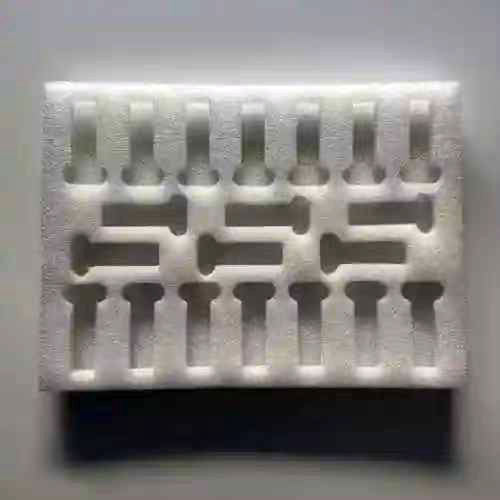
Number positions on the drawing and define packing orientation. If product variants share one insert, show which components apply to each SKU. Removable blocks or covered spare positions can support controlled variants.
Identify Fragile and No-Contact Zones
Mark displays, lenses, connectors, pins, membranes, switches, calibration seals, labels and soft coatings. Place support on structural housing areas. A cavity should control movement without continuously pressing sensitive features.
For probes and cables, define bend radius, connector protection and removal method. Heavy accessories should not sit above a fragile instrument unless a separate load path protects the device.
Protect finished surfaces
Test direct foam contact with actual production coatings and optical surfaces. A bag, film or compatible liner may be required. Design the cavity around the protected condition, including folds and seam thickness.
Choose Cavity Fit for Safe Removal
A tight cavity can look secure yet force an operator or customer to pull on a connector or delicate control. Use finger notches, lead-ins and approved grip zones. Evaluate loading and removal with gloves if that reflects the real process.
The smallest product tolerance must remain controlled and the largest must fit without excessive compression. Check every cavity in a high-count tray; positional error can accumulate across rows.
Define Cleanliness Before Quotation
State acceptable particles, odour, stains and loose foam. Describe production-area, bagging and handling requirements. If the insert enters a controlled environment, the buyer should provide its specific cleanliness protocol and validation expectations.
Do not use the words medical grade or cleanroom grade without an agreed material and evidence. A packaging supplier should confirm what controls it can provide for the project rather than imply universal suitability.
Separate sterile barrier from cushioning
If the product has sterile packaging, show the sealed barrier system and define how EPE sits outside it. Foam should not damage seals, puncture film or interfere with validated sterile-barrier packaging. Regulatory specialists should approve the complete configuration.
Review ESD Requirements for Electronics
Finished medical electronics may or may not require electrostatic protective packaging. The buyer should define device sensitivity and the ESD control plan. If specialised foam is required, state resistance range, test method, conditioning and documentation.
Colour alone does not prove antistatic or conductive performance. Standard white or black EPE should be selected for mechanical needs unless the specified grade provides verified electrical properties.
Use Layered Construction for Mixed Heights
Layered EPE can create different cavity depths for a device, charger, probe and accessories. The drawing should show each layer, thickness, alignment and bond. Thin walls and unsupported bridges require inspection.

A removable top pad may control vertical movement and protect accessories. Confirm that the lid closes without loading a screen or connector. Test the complete carton or hard case.
Integrate Labels and Instructions
Define which labels and barcodes must remain visible and whether foam may touch them. Use a packing diagram when component orientation matters. Do not let instructions become a loose object that rubs a display.
If the insert carries a part-number label, review adhesive, location, cleaning and traceability. The label should not be confused with the device identification or regulatory labelling.
Plan Shipping and Storage Risks
State whether the kit travels by parcel, pallet, air or ocean freight and whether it will be stored for long periods. Temperature, humidity, stacking and repeated handling can affect the package. EPE is not a complete moisture barrier.
High-value instruments may justify an instrumented or monitored route trial. The buyer selects drop, vibration, compression and environmental tests appropriate to the product and market.
Approve the Complete Sample
Fit and user check
Load production-representative devices and every accessory. Check orientation, removal, surface contact, cable bend, label visibility and box closure.
Packaging validation
Run the buyer-defined distribution and environmental sequence. Inspect function, calibration as applicable, cosmetic condition, foam damage and component movement.
Revision approval
Record material grade, layer construction, dimensions, tolerances and approved sample. Link the drawing, purchase order and inspection plan to one revision.
Bulk Quality and Traceability
Typical controls include material identity, outside size, cavity position, thickness, layer alignment, bond integrity, cleanliness, fit, appearance and count. Agree sampling and nonconformance handling.
Use lot or batch identification where the buyer requires traceability. Require written approval for material, process, construction or supplier changes. Retain an approved reference sample for recurring production.
Regulatory and Material Documentation
Provide a project-specific document list covering the exact material and packaging use. This may include composition, restricted-substance evidence, declarations or customer forms. Regulatory requirements depend on device classification, contact, market and packaging role.
An EPE medical device packaging supplier should not claim that ordinary foam makes a device compliant. The responsible manufacturer maintains the device and packaging validation file.
Evaluate the Packaging Supplier
Ask how drawings, material grades, samples and revisions are controlled. Review the factory’s ability to identify critical dimensions, protect clean parts during packing and trace a delivered lot. The audit should focus on the processes relevant to the actual instrument rather than a generic facility tour.
Request blank or redacted examples of first-article and final-inspection records. Confirm who approves substitutions and how nonconforming material is segregated. A low quotation is not useful if the supplier cannot maintain the approved cavity or cleanliness condition across repeat deliveries.
Plan Forecasts and Launch Quantities
Provide prototype quantity, validation quantity, initial production build, normal call-off, annual demand and programme life. Separate engineering samples from saleable production. If the medical device launch date depends on packaging validation, include approval milestones before the first large release.
Ask for quantity tiers with pieces per carton, carton dimensions and delivery assumptions. This supports capacity and landed-cost planning without forcing the buyer to hold excessive packaging inventory during an early product launch.
Information for a Medical-Instrument RFQ
- device and accessory drawings, weights and samples;
- bill of materials and packing orientation;
- screens, connectors, seals and no-contact areas;
- usable carton or case dimensions;
- cleanliness, bagging and controlled-area requirements;
- ESD, material and documentation specifications;
- distribution and environmental test requirements;
- annual quantity, release batches and launch date;
- European destination and required labels;
- approval, traceability and change-control process.
Request an Instrument Packaging Review
Send Hongying the complete kit list, product drawings, case dimensions, annual forecast and document checklist through the custom EPE foam quotation form. The team can review layout and sampling information. For sensitive electronics, see the electronics insert buyer guide.
Frequently Asked Questions
Is standard EPE sterile or cleanroom qualified?
No. Do not assume either property. Buyers must define cleanliness, environment, bagging and evidence for the specific project.
Can EPE sit outside a sterile barrier package?
Potentially, if the device manufacturer validates the complete configuration and the foam does not damage or interfere with the sterile barrier.
Does every medical electronic device need antistatic foam?
No. The decision depends on device sensitivity and the ESD control plan. If required, specify measurable performance and test conditions.
What information speeds up sample development?
Provide a complete production kit, controlled drawings, case dimensions, fragile areas, cleanliness needs and the approval test. Clearly identify any prototype-to-production differences.